
Look closely at the golden-yellow hue of the curries served in your kitchen today. That color isn’t just a basic visual element of Indian culinary habits; it is a literal thread tying you to one of the oldest, most resilient wellness legacies in human history. For generations, Indian households have reached for haldi to heal wounds, brighten skin, bless weddings, and breathe life into daily meals. But have you ever paused to ask why this humble root became so deeply embedded in our collective consciousness?
The undeniable truth is that the comprehensive turmeric history in India boasts isn’t a modern marketing trend engineered by corporate wellness giants. It is a 4,000-year-old structural epic of survival, cellular healing, and spiritual reverence. In this ultimate historical exploration, we will unearth the deep haldi history, map out the incredible turmeric ancient uses across ancient civilizations, and analyze how studying the extensive turmeric history in India uncovers the bedrock of global Indian spice culture.
Table of Contents
The Roots of Gold: Unearthing the Haldi History
To truly appreciate the deep-rooted impact of the turmeric history in India preserves, we have to travel back in time through archaeological discoveries. Modern food historians and scientists don’t rely on mere folklore; they look at physical proof. According to peer-reviewed excavation reports from the Archaeological Survey of India (ASI), chemical analysis of ceramic cooking pots excavated from ancient sites like Harappa and Mohenjo-daro revealed distinct traces of starches from turmeric and ginger.
This proves that even in 2500 BCE—more than 4,500 years ago—the people of the Indus Valley Civilization were already harvesting, grinding, and cooking with raw turmeric roots. When we analyze this prehistoric timeline, the structural foundation of turmeric history in India becomes undeniably clear. If you want to understand how modern laboratory data validates what these ancient civilizations practiced everyday, check out our scientific master-guide on Turmeric Powder Health Benefits: What Science Says About Pure Haldi.
The Vedic Timeline and Sacred Nomenclature
As the centuries rolled on, the incredible turmeric history in India chronicles moved from simple tribal cooking pots into the highly sophisticated literature of the Vedic period. Written text found in ancient Sanskrit manuscripts dating back to the Vedic era (around 1500 BCE) elevates haldi from a simple kitchen spice to a divine substance.
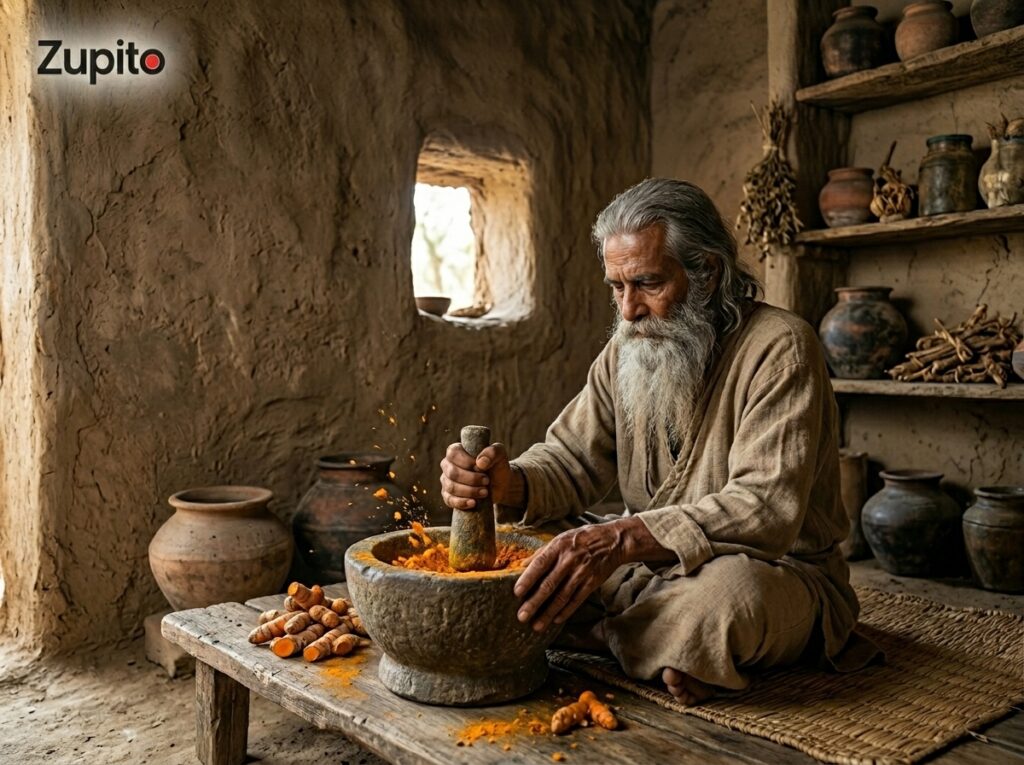
In ancient Sanskrit texts, turmeric was given over 55 distinct names, each highlighting a specific miraculous property:
- Kanchani: The Radiant Golden Goddess.
- Nisha: That which is as beautiful and deep as the starry night.
- Krimighni: The ultimate destroyer of microbes, worms, and infection.
- Varavarnini: The one that bestows a glowing, flawless complexion.
When we study haldi history alongside the timeline of turmeric history in India, we quickly realize that our ancestors didn’t look at this plant as a mere commodity. They recognized it as a living, organic form of solar energy trapped within an earthly root. It was handled with absolute reverence, a stark contrast to how modern corporate factories treat spices today.
Turmeric Ancient Uses: Beyond the Kitchen Spice Box
The multi-dimensional nature of turmeric ancient uses is what makes it unique among global agricultural crops. It was never restricted to the kitchen stove. Instead, ancient India utilized haldi across distinct pillars of daily life, creating a massive chapter within the core turmeric history in India.
1. The Ayurvedic Healing System (Vedic Medicine)
Long before modern pharmaceutical labs isolated active curcumin compounds, ancient rishis and practitioners codified the definitive medical framework of turmeric ancient uses. In classic Ayurvedic texts like the Charaka Samhita and Sushruta Samhita, turmeric is recognized as a powerful balancing herb for all three bodily humors (Doshas): Vata, Pitta, and Kapha.
Ancient physicians utilized ground turmeric powder to treat blood impurities, heal external wounds, fix chronic skin infections, and clear upper respiratory blockages. Tracing this therapeutic application emphasizes how deep the roots of turmeric history in India actually go. The classic Haldi Doodh (Golden Milk) that our grandmothers forced us to drink when we had a cold isn’t an old wives’ tale—it is a direct, unbroken application of a 3,000-year-old Ayurvedic anti-inflammatory protocol designed to protect cellular immunity naturally.
🌿 Purity Check: Ayurvedic healing relies entirely on active botanical oils. If you are trying to recreate ancient remedies at home, ordinary supermarket packets won’t cut it. Consider integrating our specialized Zupito Pure Turmeric Powderand slow-milled Zupito Coriander Powder into your daily routine to experience authentic, uncompromised wellness.
2. Cultural and Spiritual Rituals
In the tapestry of traditional Indian spice culture, turmeric represents the ultimate symbol of purity, fertility, and auspiciousness. When documenting the sacred turmeric history in India, it is precisely why no traditional Hindu wedding is ever complete without the sacred Haldi Ceremony. The ritualistic paste applied to the bride and groom wasn’t designed just for aesthetic skin brightening; it was a protective spiritual and physical shield meant to ward off infections and purify the aura before entering holy matrimony.
Similarly, during ancient times, dynamic warriors would paint their protective armor or weapons with fresh turmeric paste before marching onto the battlefield, relying on its natural antiseptic properties to instantly seal any physical cuts sustained during combat. This ritual adds an unforgettable martial element to the legendary turmeric history in India.
📦 The Ultimate Kitchen Defense: Your daily cooking deserves the same royal treatment as ancient rituals. Instead of buying individual packs, most health-conscious households switch to the comprehensive Zupito Premium Spice Combo Pack, which brings together the unadulterated power of cold-ground Haldi, Dhaniya, and fiery Mathania Mirch in one perfect ecosystem.
How Turmeric Shaped the Global Indian Spice Culture
You cannot discuss the historical architecture of global trade routes without talking extensively about Indian spice culture. India has historically been the undisputed spice capital of the world, and tracing the turmeric history in India guards reveals it was the undisputed golden currency that merchants from all over the globe traveled thousands of miles to secure.
Through ancient maritime trade networks, Indian traders carried premium dried turmeric roots across the rough waters of the Indian Ocean to Babylon, ancient Egypt, and Rome. Around 700 CE, Indian monks and merchants introduced turmeric to China, where it was immediately absorbed into Traditional Chinese Medicine (TCM) to regulate gallbladder and liver wellness channels.
This global fascination with the deep, vibrant golden color and pungent, earthy flavor profile of authentic Indian haldi firmly established India as the true guardian of global botanical wellness. It is exactly this incredible legacy that positions certain standard frameworks above modern commercial mills. Read our complete analytical analysis on what criteria sets apart the Best Masala Brand in India: Ultimate 2026 Comparison Guide to see how ancient quality parameters and the spirit of turmeric history in India are maintained today.

By the time the famous explorer Marco Polo encountered this brilliant root in 1280 CE during his extensive travels, he wrote in his journals with utter fascination:
“There is also a vegetable which has all the properties of true saffron, as well the smell as the color, and yet it is not really saffron.”
The Modern Tragedy: Why Mass-Produced Haldi Fails the 4,000-Year Legacy
Now, let’s step back into the present day and look at a deeply painful reality. We talk proudly about our 4,000-year-old turmeric history in India legacy, but the modern store-bought spice powders we consume today have been stripped of their ancient soul.
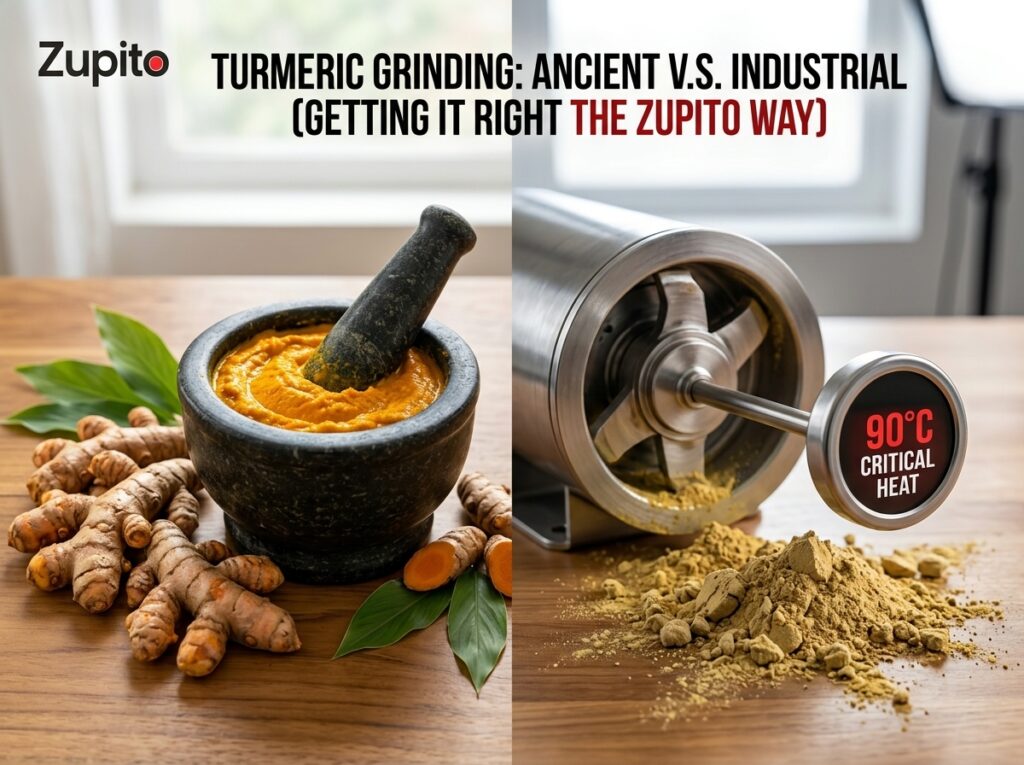
To satisfy the demands of mass-market commercial capitalism, corporate spice giants rely on hyper-industrial, high-speed steel grinding mills. These aggressive industrial rollers generate intense kinetic friction heat, with internal temperatures soaring up to 90°C.
The Evaporation of Curcumin and Essential Oils
This aggressive milling heat literally boils away the fragile volatile oils (like turmerone and atlantone) and degrades the highly therapeutic curcumin molecules hidden within the root. Curcumin is the exact bio-active compound responsible for the rich health benefits and distinct golden-yellow pigment of haldi.
When you grind a root at high heat, you are left with nothing but a dead, chemically exhausted yellow powder that has zero medicinal value, completely violating the historic parameters of turmeric history in India. To make matters worse, low-grade mass-market brands frequently blend artificial lead chromate colorings, chalk powder, or cheap starch fillers to maintain volume and color consistency, violating the strict purity standards set by the FSSAI (Food Safety and Standards Authority of India).
When you consume such adulterated products, you aren’t engaging with true Indian spice culture or the true essence of turmeric history in India; you are putting your long-term cellular health at massive risk. Curious about how we break this corporate cycle and keep our spices completely alive without losing their therapeutic values during the milling stage? Take a transparent look at our step-by-step processing structural breakdown in our foundational piece on How Coriander Powder is Made to see our eco-friendly cold-ground commitment firsthand.
Reclaiming Purity with Zupito Cold-Ground Turmeric Powder
Your health and your ancestral legacy deserve absolute purity. To experience the uncompromised medical strength that our ancestors discovered thousands of years ago during the evolutionary phase of turmeric history in India, it is time to throw out the dead supermarket corporate powders and switch to the raw power of Zupito Turmeric Powder.
At Zupito, we have initiated an eco-friendly cold-ground revolution to preserve the historical integrity of our spices. We source premium, single-origin turmeric rhizomes and grind them at strictly monitored, low temperatures. By eliminating brutal processing heat, we ensure that 100% of the live volatile oils and the maximum possible natural curcumin content stay entirely intact inside every packet.
Whether you want to buy single packs of Zupito Mathania Red Chilli Powder or stock up your pantry with our signature Zupito Spice Combos, you are investing in a product certified for absolute purity, clean sourcing, and zero heat damage. No synthetic fillers, no artificial dyes, and absolutely no compromises—just raw, unadulterated golden purity matching the strict historical standards of the original turmeric history in India.
Conclusion: Honoring the Golden Legacy in Your Daily Life
Every time you sprinkle a pinch of pure haldi into your food, you are practicing an ancient, unbroken art of healing that has survived for over forty centuries. Understanding the true depth of turmeric history in India allows us to realize that spices aren’t just commodity powders; they are dynamic medicine. Let’s honor this legacy by choosing purity over corporate convenience. Switch to slow-processed, cold-ground spices, and let the authentic wellness of ancient India protect your family’s health for generations to come.
Ready to Upgrade Your Kitchen with 100% Cold-Ground Purity?
Don’t let dead, heat-damaged mass-market corporate spices ruin your weight loss journey and wellness goals. Experience the pure, aromatic shift with Zupito’s single-origin, micro-batched masale.
👉 Visit the Official Zupito Shop Now & Grab Your Pure Wellness Combo!
- 100% Volatile Oils Intact (For genuine health benefits)
- Zero Artificial Colors, Fillers, or Preservatives
- FSSAI Certified & Cold-Ground Processed
Frequently Asked Questions (FAQs)
Q1. What is the real origin of turmeric in historical texts?
Turmeric originates natively in the Indian subcontinent. The earliest physical evidence dates back 4,500 years to the Indus Valley Civilization, while its extensive therapeutic and spiritual uses were systematically documented across the extensive timeline of turmeric history in India over 3,000 years ago.
Q2. Why did ancient Indians use turmeric during weddings?
Ancient Indians used turmeric during the Haldi ceremony because of its twin properties: it acts as an absolute natural aesthetic skin purifier for a healthy glow, and its deep antimicrobial properties physically protected the bride and groom from catching seasonal infections before the wedding rituals.
Q3. What did ancient Ayurveda call turmeric?
In ancient Ayurvedic medical texts, turmeric was recognized by multiple Sanskrit names, most notably Krimighni (the ultimate germ killer), Kanchani (the golden goddess), and Haridra (dear to the god Hari/nature).
Q4. Is store-bought haldi powder the same as ancient haldi?
No. Regular store-bought powders are processed using high-speed industrial grinders that burn away essential oils and active curcumin molecules due to high heat. Ancient haldi was slow-pounded manually, keeping all nutrients alive. To get the same ancient benefits today, you should use cold-ground options like Zupito.
Want to explore more historical kitchen wellness? Do check out our breakdown on Coriander Powder for Weight Loss: Does Dhaniya Actually Help You Shed Kilos? to learn how to pair ancient metabolic spices to supercharge your daily morning detox routine seamlessly.
Leave a Reply