
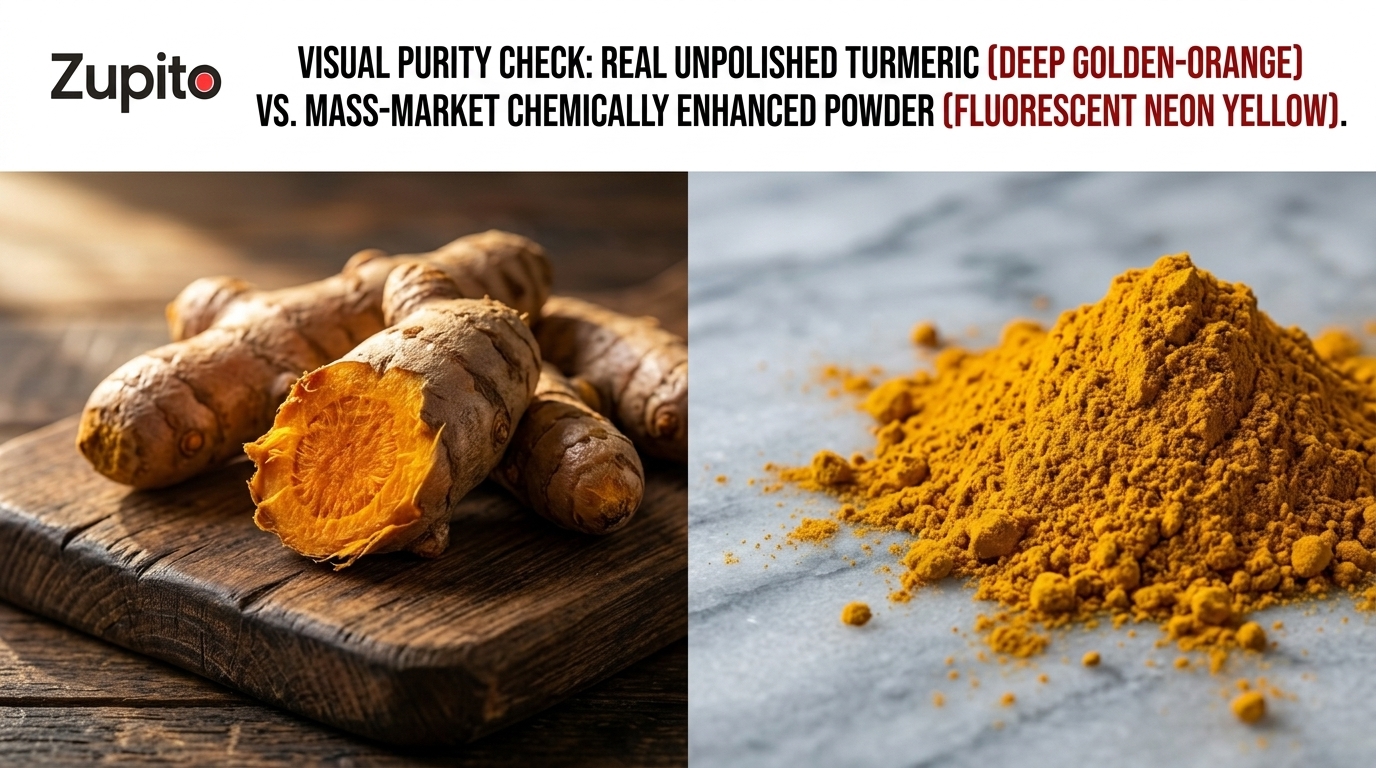
The golden spice sitting in your kitchen cabinet might look vibrant, but it could be quietly harboring a slow-poisoning health crisis. When you tear open a standard grocery store spice pouch or randomly order a cheap bag from a mega ecommerce platform, you assume you are purchasing a medicinal powerhouse. After all, Indian households depend on turmeric for everything from daily subzis to healing immunity drinks.
However, the commercial reality of the modern spice supply chain is deeply unsettling. Most mass-produced turmeric on the market today isn’t pure; it is an industrially modified, polished, and chemically enhanced powder engineered to look perfect while being completely hollow on the inside. Every conscious cook must master the chemical reality of how to spot real haldi to shield their family’s long-term metabolic health safely.
For centuries, turmeric has been revered as a natural shield against systemic inflammation, free radical damage, and chronic digestive disorders. Yet, when you consume highly processed, chemically altered variants, you aren’t getting those protective botanical properties. Instead, you are introducing hazardous industrial fillers into your gut.
If you truly want to protect your family’s health, learning the step-by-step methods of how to spot real haldi is non-negotiable. This exhaustive guide exposes the subterranean world of spice manipulation and gives you the exact blueprint to protect your kitchen from industrial fraud when shopping online. By mastering how to spot real haldi, you ensure your body receives actual therapeutic support rather than chemical waste lines.
Table of Contents
The Anatomy of Spice Deception: Why Industrial Brands Fake Your Haldi
To understand why genuine turmeric is so rare in the commercial market, one must look at the economics of industrial spice manufacturing. Turmeric is priced globally based on its internal chemical composition and visual appeal. However, processing raw turmeric roots into a shelf-stable powder requires meticulous care, time, and temperature control.
Mass-market brands operating on razor-thin profit margins simply cannot afford this level of precision. To maximize their volume and slash retail costs, they turn to aggressive industrial adulteration. Because of this widespread corruption, knowing how to spot real haldi has become the single most vital survival skill for smart grocery buyers. If you don’t know how to spot real haldi, your kitchen remains vulnerable to toxic additives.
When low-grade, damaged, or completely exhausted turmeric roots are processed in high-speed, high-heat commercial mills, the mechanical friction spikes the temperature up to 100°C. This extreme thermal stress entirely vaporizes the volatile essential oils and degrades the delicate active compounds. The result is a dead, dull, brownish-grey fibrous powder that smells like scorched wood.
To make this lifeless waste product saleable to unsuspecting consumers, factories deploy synthetic colorants, starch fillers, and polishing agents to mimic the appearance of a premium harvest. This cosmetic deception is precisely why users search for guidelines on how to spot real haldi before making an online purchase. Without a clear plan on how to spot real haldi, buying turmeric becomes an organic lottery.
The Toxic Ingredients Hiding in Your Polished Turmeric Powder
When you consume adulterated turmeric powder, the health risks are severe. Industrial spice processors do not use food-grade additives to enhance their low-grade inventory; they utilize highly cost-effective industrial chemicals that can cause long-term metabolic damage. If you do not learn how to spot real haldi, you will end up serving these hazardous chemicals daily.
Investing time to understand how to spot real haldi is the only way to intercept these hidden dangers before they enter your digestive tract. According to public food safety updates managed by the official Food Safety and Standards Authority of India (FSSAI) as well as global regulatory alerts by the World Health Organization (WHO), consuming unverified market powders frequently exposes consumers to aggressive toxic materials designed to mask structural product degradation lines.
Lead Chromate: The Deadly Yellow Dye
This is by far the most dangerous and widespread adulterant found in unverified turmeric worldwide. Lead chromate is an industrial chemical pigment primarily used in plastics, varnishes, and printing inks. Because it possesses a striking, brilliant golden-yellow hue, unscrupulous processors dust it over low-grade or rotten turmeric roots during the polishing phase.
Regular ingestion of lead chromate leads to severe heavy metal poisoning, irreversible neurotoxicity, cognitive impairment, and profound damage to the kidneys and central nervous system. This danger alone makes understanding how to spot real haldi an absolute necessity for every household. When you share guides on how to spot real haldi, you protect your community from heavy metal toxicity.
Metanil Yellow: The Carcinogenic Illusion
Metanil yellow is a synthetic acid dye extensively used in the textile industry to color wool and silk fabrics. It is strictly prohibited for human consumption under global food safety standards. Yet, because it can instantly transform a lifeless, starch-heavy mixture into a vibrant yellow product, it is frequently used to tint fake spices.
Medical studies consistently link chronic metanil yellow consumption to severe gastrointestinal irritation, localized cell mutations, and direct hepatotoxicity. Learning how to spot real haldi completely bypasses this chemical hazard. Once you grasp how to spot real haldi, artificial textile dyes lose their ability to fool your eyes.
Chalk Powder, Gypsum, and Industrial Starch
To artificially inflate the net weight of a spice packet without raising production costs, factories blend their turmeric with heavy mineral powders like calcium carbonate (chalk), gypsum, or cheap industrial-grade corn starch. While these mineral fillers may not cause immediate acute poisoning, they severely irritate the lining of the stomach, create chronic kidney stone vulnerabilities, and completely dilute the nutritional potency of the spice.
Once you master the tactical techniques of how to spot real haldi, you can detect these mineral contaminants instantly. The baseline foundation of how to spot real haldi rests on identifying these synthetic textures early.
Real Haldi vs Polished Powder: The Ultimate Structural Comparison
Identifying pure spices requires shifting your focus away from superficial cosmetic perfection. Industrial factories have mastered the art of making fake powders look incredibly attractive, but they can never replicate the molecular structure, density, and natural aroma profile of a pristine, uncompromised botanical grind.
Understanding how to spot real haldi involves evaluating the raw structural properties of the powder rather than its marketing package. Let’s look at a clear verification breakdown to see how to spot real haldi at a single glance.
| Structural Property | Polished Industrial Powder (Fake) | Real Haldi (Authentic) |
|---|---|---|
| Primary Hue | Artificially uniform, intensely fluorescent, bright neon yellow. | Deep, warm golden-orange with natural, subtle shade variations. |
| Aroma Profile | Chemically pungent, metallic, flat, or completely odorless. | Intensely earthy, distinctly woody, warm, and highly aromatic. |
| Texture & Grain | Chalky, ultra-smooth, free-flowing, and completely uniform. | Slightly fibrous, naturally dense, packs down tightly when pressed. |
| Behavior in Water | Leaves a thick, sticky residue; instantly dyes water bright yellow. | Settles purely at the bottom; leaves the water translucent pale yellow. |
| Curcumin Retention | Highly degraded or utterly stripped out during processing (<1.5%). | Naturally intact, highly potent medicinal concentration (>3.5%). |
When you open a pack of authentic, unpolished turmeric, the aroma should immediately transport you to an agricultural field. It possesses a multi-layered, comforting earthiness that synthetic alternatives can never truly duplicate. If you understand how to spot real haldi, you will know that its true power lies in its deep smell rather than its artificial brilliance.
If your current kitchen turmeric lacks that deep, grounding fragrance and looks like a bright yellow fluorescent dye, it is highly likely that your spice has been industrially polished. This structural contrast is the primary pillar when teaching anyone how to spot real haldi.
The Curcumin Paradox: Why High-Heat Grinding Destroys Healing Benefits
The entire health narrative surrounding turmeric hinges on a single, miraculous polyphenol compound: curcumin. This active component is responsible for the spice’s deep golden color, its profound anti-inflammatory properties, its ability to neutralize systemic free radicals, and its time-tested capacity to accelerate muscle and tissue recovery.
If you extract curcumin from the equation, turmeric ceases to be a functional medicinal asset. Therefore, a core pillar of how to spot real haldi is checking how the root was ground. When learning how to spot real haldi, always analyze the thermal processing behind the label.
The tragedy of mainstream commercial spice manufacturing is that traditional high-speed hammer mills operate at extreme rotational velocities. This mechanical friction generates intense localized heat that regularly exceeds 85°C to 100°C. Curcumin is highly heat-sensitive; when exposed to these sustained thermal spikes during the grinding process, the compound molecularly breaks down and oxidizes.

The essential therapeutic oils that act as bio-availability carriers for curcumin are simultaneously cooked away and lost forever. This is why knowing how to spot real haldi requires looking deep into cold-milling technology. To experience the profound anti-inflammatory benefits of this ancient root, you must look for a cold ground haldi that has been processed in temperature-controlled environments.
By maintaining an ambient processing temperature below 30°C, the natural cellular structure of the spice root is fully preserved. The curcumin remains uninjured, the volatile oils stay locked within every grain, and the spice retains its maximum biological potency. Knowing these backend engineering choices is how professionals teach consumers how to spot real haldi seamlessly. When you understand this thermal logic, you unlock the core secret of how to spot real haldi.
The 3-Second Kitchen Laboratory: How to Test for Purity at Home
You do not need an advanced degree in chemical engineering or expensive laboratory equipment to verify if you are consuming pure botanical roots or an adulterated turmeric powder mixture. You can execute three definitive, foolproof purity tests right inside your kitchen using basic household items.
This practical system outlines how to spot real haldi without spending a fortune. Let’s explore these testing modules so you know exactly how to spot real haldi whenever you unbox a new package.
Test 1: The Ambient Water Suspension Test
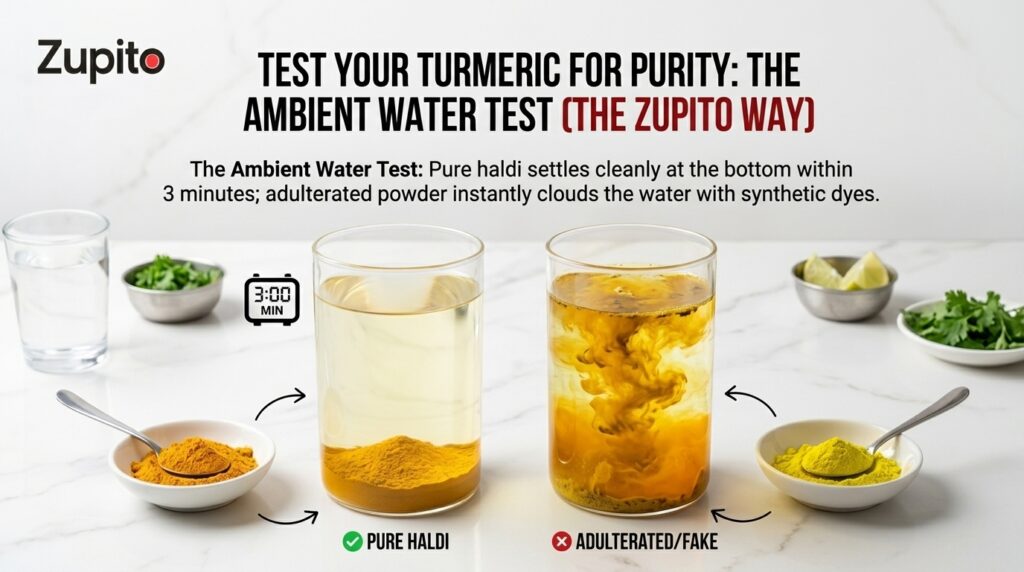
Take a clean glass and fill it with lukewarm water. Gently drop half a teaspoon of your turmeric powder directly onto the surface of the water. Do not stir or agitate the glass. Leave it completely undisturbed for three to five minutes. This is the absolute fastest method for how to spot real haldi.
If you want a quick diagnostic test on how to spot real haldi, the water test is your ultimate gold standard tool. Fake powder will make the water intensely cloudy instantly. Authentic turmeric slowly drifts downward and settles at the bottom, keeping the suspension clear.
Test 2: The Hydrochloric Acid Purity Check
Take a small pinch of your turmeric powder and place it into a small glass container. Add a few drops of water to create a thick paste, and then pour in a small amount of clear hydrochloric acid or concentrated household toilet cleaning acid. If you want a chemical protocol on how to spot real haldi, this is it.
This test removes any doubt on how to spot real haldi when dealing with complex industrial dyes. If the mixture flashes deep purplish-red that stays after shaking, it indicates a high concentration of metanil chemical adulterants.
Test 3: The Palm Rub Concentration Test
Place a small pinch of turmeric powder directly onto the center of your left palm. Using your right thumb, press down firmly and rub the powder continuously against your skin for about ten to fifteen seconds. Turn your hand vertically and blow away the excess loose powder. This simple physical interaction is an ancient masterclass on how to spot real haldi.
Practicing this test builds your intuitive understanding of how to spot real haldi through physical touch layers. Mineral fillers drift away cleanly, while genuine unpolished powder locks a persistent, warm, buttery golden coat safely within your skin folds.
How to Safely Buy Pure Turmeric Powder Online Without Getting Scammed
Sourcing authentic dietary essentials on the modern internet can feel like navigating a minefield. The digital marketplace is saturated with white-labeled drop-shipping brands that spend heavily on glossy lifestyle photography and micro-influencer campaigns, yet source their inventory from the exact same bulk commodity traders who deal in low-grade, polished agricultural waste.
To cut through the marketing noise, you must use clear online validation frameworks on how to spot real haldi before checking out. When you combine digital verification with kitchen testing, mastering how to spot real haldi becomes incredibly simple.
First, completely ignore vague marketing catchphrases like “Premium Selection,” “100% Natural,” or “Hand-Selected.” These terms are not legally binding or regulated by food safety authorities. Instead, look for concrete infrastructural credentials. Does the online storefront explicitly state its processing methodology? If a brand cannot clearly guarantee that they use low-temperature processing systems, you should assume they are using high-heat industrial hammer mills that destroy curcumin.
Checking these architectural details is an advanced strategy for how to spot real haldi. This systematic filtering is the first step in learning how to spot real haldi on ecommerce sites. To balance your whole spice setup, pairing your pure turmeric purchases with an analytical view of the price of dhaniya powder guarantees your complete pantry stays highly secured against industrial shortcuts.
Second, verify the absolute purity tracking and origin metrics of the brand. Trustworthy spice purveyors maintain a transparent, direct line from localized farming cooperatives straight to their packaging facility. They explicitly list their FSSAI certification details, operate out of verified processing zones, and publish direct batch-testing indicators. When you choose to buy pure turmeric powder online, you should always prioritize small-batch, origin-focused producers who prioritize medicinal integrity over mass-market retail volumes. This proactive selection process reinforces your framework on how to spot real haldi.
The Ultimate Health Transformation: Unlocking Pure Turmeric Powder Benefits
When you eliminate industrial factory dust from your kitchen and introduce genuine, uncompromised turmeric into your daily wellness routine, your body experiences a profound physiological shift. The extensive list of pure turmeric powder benefits is thoroughly backed by modern bio-medical research and traditional Ayurvedic pharmacology alike.
However, you can only experience these changes if you understand how to spot real haldi. Investing your energy into learning how to spot real haldi guarantees that your daily morning tonics provide real cellular protection.
Chronic, low-grade systemic inflammation is the underlying driver behind almost every modern metabolic syndrome, including cardiovascular disease, type-2 diabetes, and degenerative arthritis. The active curcumin molecules in unpolished turmeric function as a powerful natural anti-inflammatory agent, down-regulating inflammatory cytokines at a cellular level and providing long-term relief for stiff, painful joints.
Learning how to spot real haldi ensures you actually receive this cellular protection. Once you realize the connection between purity and health, knowing how to spot real haldi changes from a casual tip into a daily family shield.
Every day, your body is exposed to oxidative stress caused by environmental pollutants, industrial seed oils, and emotional strain. Authentic turmeric is packed with clean antioxidants that deliver a dual-action cellular defense matrix: they directly neutralize damaging free radicals and simultaneously stimulate your body’s native antioxidant enzyme mechanisms. This complete health upgrade highlights the importance of knowing how to spot real haldi. When you know how to spot real haldi, your antioxidant intake remains highly potent and effective.
Genuine, unadulterated turmeric acts as a natural prebiotic for your intestinal microbiome. It stimulates the gallbladder to produce consistent, balanced bile, which directly improves the breakdown of dietary fats, dramatically reduces systemic bloating, and strengthens the integrity of the mucosal stomach lining against hyperacidity. This is why mastering how to spot real haldi directly impacts your daily metabolic comfort. Protecting your digestive balance requires a firm grasp on how to spot real haldi across all seasonal purchases.
Stop Consuming Polished Chemicals: Switch to the Zupito Standard
You should never have to guess whether your daily health supplements are curing you or quietly exposing your liver to industrial dyes. Now that you are fully equipped with the knowledge of how to spot real haldi, it is time to upgrade your pantry to the uncompromised standard of the Zupito High-Curcumin Haldi Pack. Sourcing a clean harvest removes the ongoing stress of trying to remember how to spot real haldi on unverified supermarket shelves.
Sourced directly from unpolished, single-origin roots grown by trusted agricultural partners in Rajasthan, Zupito Turmeric Powder contains absolutely zero fillers, zero chalk, and zero synthetic dyes. Every batch is processed using state-of-the-art Cold Grinding technology that locks in the natural essential oils, preserves the native high curcumin turmeric profile, and delivers the deep, grounding, authentic aroma that your family deserves.
Stop wondering how to spot real haldi in unverified stores and switch to a certified, small-batch harvest built entirely on transparent purity. Give your kitchen the gift of genuine purity and experience the real power of uncompromised botanical science by selecting a verified, high curcumin turmeric package designed to shield your cellular wellness permanently.
Bring authentic health back to your home today. By choosing our specialized cold ground haldi, you guarantee that your family consumes pure, unadulterated nutrition every single day. Do not compromise on your well-being or tolerate polished commercial text lines. Make the smart choice to buy pure turmeric powder online and lock in the full range of pure turmeric powder benefits with our signature Zupito High-Curcumin Haldi Pack right now. You can also explore our complete raw kitchen defense ecosystem including our cold-processed Zupito Pure Dhaniya Powder and the high-oil retention jeera to complete your metabolic upgrade.
Frequently Asked Questions (FAQs)
1. How to spot real haldi instantly in a grocery store?
Real turmeric has a deep, warm golden-orange color and an intense, earthy, woody aroma. Fake or polished turmeric looks bright, fluorescent, neon yellow and often completely lacks a distinct natural aroma due to high-heat commercial processing.
2. Does pure turmeric fully dissolve in water?
No, pure turmeric powder does not dissolve completely in water because it consists of natural botanical fibers and oils. In a glass of water, pure turmeric will slowly settle down cleanly at the bottom over 3-5 minutes, leaving the water above translucent pale yellow. If the water becomes instantly cloudy, thick, or deep yellow, it contains chalk or industrial starches.
3. What are the side effects of lead chromate in fake spices?
Lead chromate is an industrial dye that causes severe heavy metal poisoning over time. Chronic ingestion can cause irreversible neurological damage, kidney failure, digestive tract ulceration, and cognitive deficiencies. Checking how to spot real haldi protects your family from these industrial chemical additives.
4. Why is cold grinding crucial for pure turmeric powder benefits?
Traditional grinding mills operate at extreme speeds, generating heat up to 100°C which vaporizes the healing essential oils and degrades the active curcumin. Cold grinding keeps processing temperatures under 30°C, fully preserving the native high curcumin profile and natural volatile properties of the spice root.
Explore Zupito Knowledge Hub
- Expand your culinary defense matrix and discover the specialized technical science backing cold-ground spices across our dedicated operational guides:
- 5 Secrets to Spot Fake Turmeric and Verify Real Unpolished Haldi at Home
- Chilli Powder Quality Metrics: Learn how to analyze industrial starches and trace real single-origin pigments in premium red peppers inside our live 7 Best Chilli Powder Types: Why Mathania Wins Master Guide.
- Spiciness Balancing Mechanics: Discover the underlying physical science of neutralizing excess oil capsicum and fixing errors in culinary bases within our live Zupito Spice Combos and Neutralization Assessment Guide.
- Bulk Savings vs Nutrient Oxidation: Analyze the financial tradeoffs and shelf-life risks of opting for a compact coriander powder small pack versus large industrial bulk storage setups.
- Chilli Sourcing Mistakes: Learn the exact parameters to detect added artificial colorants and how to safely Buy Chilli Powder Online without falling for cheap factory traps.
- Foundational Curry Emulsions: Master how cold-milled coriander, turmeric, and high-potency oil lipids interlock to stabilize rich gravy structures in our upcoming regional spice integration modules at Shop Zupito Pure Spices & Combos Now.
- The Scientific Cooking Guide: Maximizing Biological Absorption of Native Haldi Oils
🛒 Upgrade Your Daily Cooking: Ready to experience the massive difference that cold-ground, zero-filler spices make? Explore our premium, aroma-locked Zupito Pure Coriander Powder, or pair it with our vibrant Zupito Mathania Red Chilli Powder to elevate your curries instantly. Don’t forget to check out our complete home-safety breakdown on How to Spot Adulterated Spices at Home to ensure your family’s ultimate protection! Also check out our trending guide on 9 Proven Health Benefits of Haldi Powder You Did Not Know to optimize your kitchen health setup.
Leave a Reply