
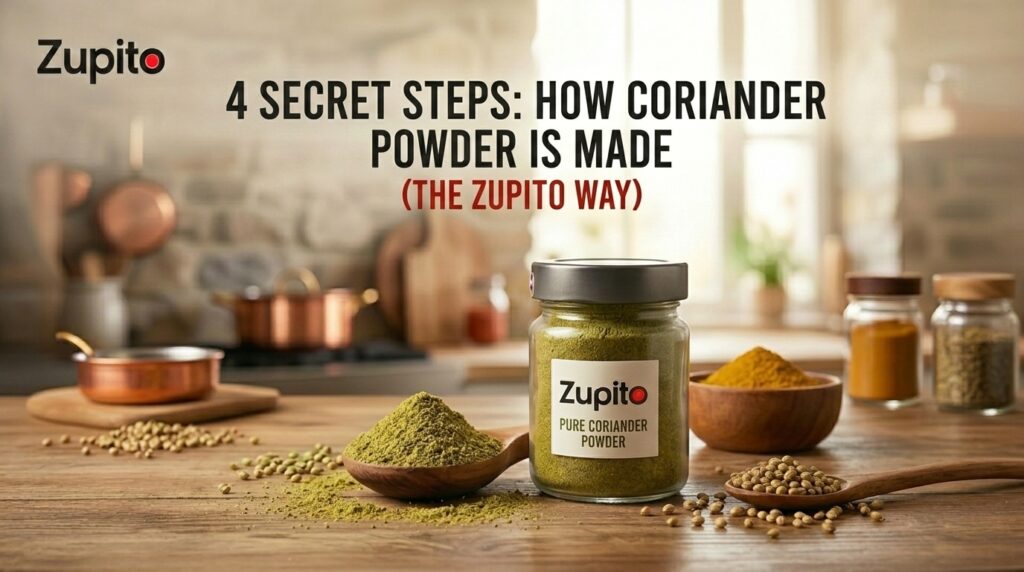
Have you ever wondered how coriander powder is made by mass-market commercial brands, and why it loses its vibrant green color and rich aroma within just a couple of weeks? You open the seal, throw a teaspoon into your hot curry, and… nothing. No soothing, earthy fragrance, just a flat, dusty texture.
The secret behind this common kitchen problem lies directly in the mass-manufacturing pipeline. Most commercial brands optimize strictly for speed and volume, sacrificing the natural volatile oils that give dhaniya its true soul.
Today, we are lifting the curtain on exactly how coriander powder is made at Zupito. From ethical farm sourcing across Rajasthan’s finest spice belts to our revolutionary temperature-controlled grinding technique, here is the complete step-by-stepdhaniya powder process that ensures you get nothing but 100% pure coriander every single time.
Table of Contents
High Heat Grid: How Coriander Powder Is Made in Mass Factories
To understand why a change is needed, we have to look at standard spice manufacturing India setups. Heavy industrial grinders run at hyper-speeds to maximize hourly output. This mechanical friction generates extreme internal heat, with temperatures often shooting past 60°C to 70°C.
Here is what happens inside those high-heat machines and how it ruins the entire pipeline of how coriander powder is made:
- Aroma Loss: Coriander seeds contain essential volatile oils (mainly linalool), which are highly temperature-sensitive. Excessive heat evaporates these oils completely, stripping away the spice’s therapeutic properties and natural aroma.
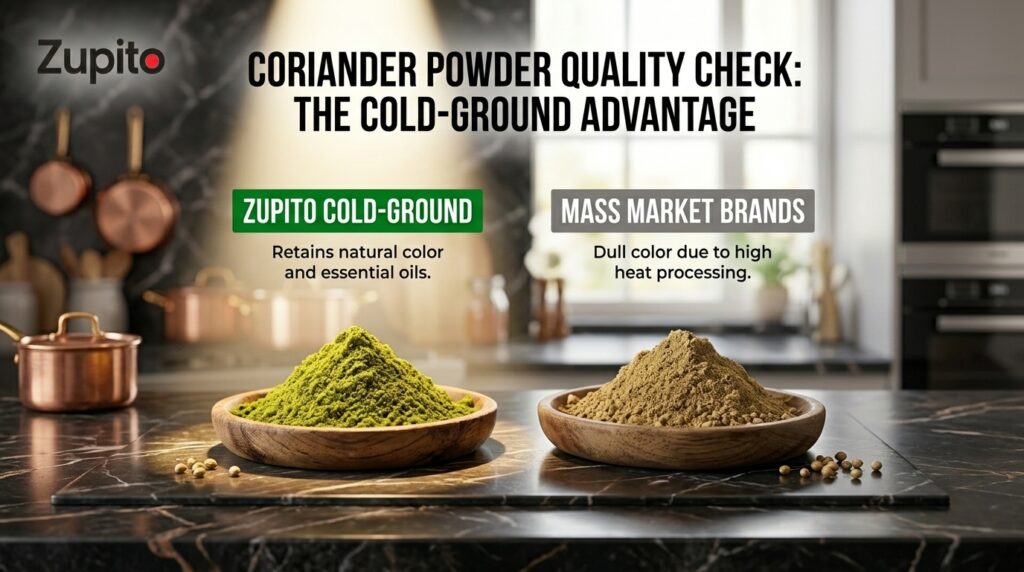
- Color Degradation: High heat burns the chlorophyll pigment, turning a beautiful natural olive-green powder into a dull, oxidized dark brown dust.
- Filler Ingestion: To keep prices artificially low, mass-market manufacturers frequently mix low-grade seeds with starch, husk, or agricultural waste, forcing families to consume toxic impurities daily. If you study how coriander powder is made in mass commercial mills, health is always compromised.
Step-by-Step: Zupito’s Seed-to-Kitchen Dhaniya Powder Process
At Zupito, we threw out the corporate mass-production playbook. We completely revolutionized the traditional blueprint of how coriander powder is made to build a clean, transparent supply chain focused entirely on preserving natural health properties and true spice potency. Here is our meticulous 4-step processing cycle:
Step 1: Elite Sourcing from Vibrant Spice Belts
Our setup changes the way how coriander powder is made right from the roots. We coordinate with local farmers in the premium spice-growing regions of Rajasthan. We exclusively select single-origin, plump, fully matured green coriander seeds that are naturally dense in essential oil content. No mixing with old, hollow, or decayed stalks.
Step 2: Natural Sun-Drying & Triple-Stage Cleaning
Understanding how coriander powder is made cleanly means focusing on hygiene. Once harvested, the seeds undergo a natural sun-drying cycle to reduce moisture levels safely without structural cellular damage. Next, they pass through a triple-stage mechanical and manual sorting process to completely filter out pebbles, dust, and wild seeds. No chemicals or synthetic washes are ever introduced.
Step 3: The Cold-Ground Revolution (Locking the Aroma)
This is where the real magic happens. Instead of using high-speed hammer mills, Zupito utilizes slow-moving, traditional-style cold-grinding technology. By monitoring and maintaining a low, stable temperature during the crushing process, we ensure that the active essential oils never overheat or evaporate. This is the ultimate cornerstone of how coriander powder is made cleanly—the cellular walls break down gently, sealing the rich linalool oil compounds perfectly inside every single particle.
Step 4: Moisture-Lock Hygienic Packaging
The freshly ground powder is instantly routed into our clean-room packaging zone. If you track how coriander powder is made in our facility, you will see it is packed in specialized, air-tight barrier pouches that protect the spice from light, air, and humidity. No artificial green dyes, no synthetic preservatives, and zero anti-caking chemical agents are added. Our structural audit shows this is exactly how coriander powder is made to stay fresh for up to a year.
Pure Coriander vs. Commercial Brands: Quick Reference Guide
To help you audit what is currently sitting inside your kitchen cabinet, look at how Zupito’s slow-grinding process stands up against mass-market alternatives:
Daily Intake & Purity Matrix
| Parameter | Zupito Authentic Process | Mass-Market Brands |
| Grinding Method | Slow-Speed Cold-Grinding (Low Temp) | High-Speed Hammer Mills (High Temp) |
| Essential Volatile Oils | 100% Intact & Sealed (Rich Linalool) | Burned off due to high mechanical friction |
| Natural Color | Rich, organic olive-green tone | Dull, scorched dark brown shade |
| Artificial Fillers | Absolutely Zero (100% Pure Seed Content) | Often blended with starch, industrial husk, or dust |
| Aroma Lifespan | Stays pungent for months naturally | Fades away within a few weeks of opening |
Unlocking the Daily Health Benefits of Pure Coriander
When you understand how coriander powder is made correctly and consume it without any toxic adulterants, it operates as a highly active functional superfood for your body:
- ⚡ Boosts Digestion and Relieves Bloating: Pure coriander oils stimulate pancreatic enzymes, accelerating smooth food breakdown and directly preventing intestinal gas.
- 🩸 Regulates Blood Sugar Levels: Clinical nutritional studies overseen by statutory bodies like the Spices Board India indicate that active coriander compounds help support optimal insulin secretion, making it excellent for long-term metabolic health.
- 🌿 High Antioxidant Shield: Just like the intense cellular protection found in our recent breakdown of Red Chilli Powder Daily Benefits, pure coriander is packed with vital antioxidants that neutralize internal systemic inflammation. Knowing how coriander powder is made helps you appreciate these therapeutic traits.
Frequently Asked Questions (FAQs)
Q1. How coriander powder is made at Zupito—is it completely chemical-free?
A: Yes! Our entire production loop uses zero chemical washing, zero artificial colors, and zero anti-caking agents. It is 100% raw, cold-ground, single-origin seed powder.
Q2. Why is Zupito’s coriander powder slightly green compared to others?
A: Our unique low-temperature cold-grinding technique ensures that the natural chlorophyll inside the coriander seeds is never burned or oxidized. The green tint is proof of how coriander powder is made without intense thermal heat!
Q3. How should I store my coriander powder to keep it fresh?
A: Always keep your spice jar in a cool, dry, and dark corner of your pantry. Ensure the lid is locked tightly immediately after use to prevent ambient moisture from degrading the natural essential oils.
Conclusion: Clean Up Your Kitchen Pantry Today
Ultimately, the choice comes down to prioritizing your family’s daily health. By tracking exactly how coriander powder is made globally and moving away from cheap, hyper-processed, high-heat commercial varieties, you ensure that your daily meals remain entirely toxin-free while capturing the explosive, authentic flavor of traditional Indian heritage cooking.
Always look for certified sourcing parameters established by leading regulatory authorities like the Food Safety and Standards Authority of India (FSSAI) to keep your kitchen safe from modern food adulteration traps.
🛒 Upgrade Your Daily Cooking: Ready to experience the massive difference that cold-ground, zero-filler spices make? Explore our premium, aroma-locked Zupito Pure Coriander Powder, or pair it with our vibrant Zupito Mathania Red Chilli Powder to elevate your curries instantly. Don’t forget to check out our complete home-safety breakdown on How to Spot Adulterated Spices at Home to ensure your family’s ultimate protection! Also check out our trending guide on 9 Proven Health Benefits of Haldi Powder You Did Not Know to optimize your kitchen health setup.
Leave a Reply