
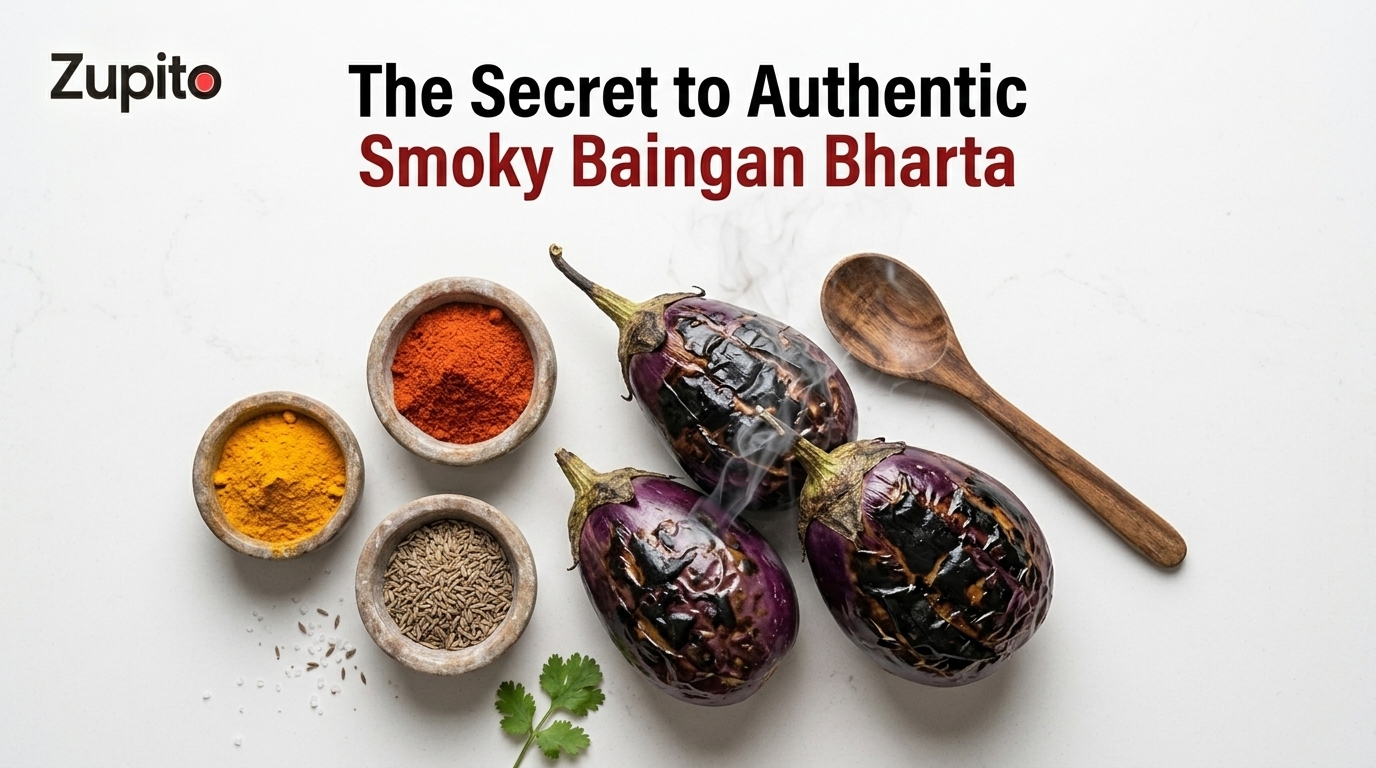
The culinary art of traditional Indian cooking relies heavily on capturing raw, primal volatile elements directly from open flames to transform simple agricultural produce into deep gourmet masterpieces.
Among all classic North Indian preparations, a masterfully executed baingan bharta recipe stands out as the ultimate litmus test for understanding smoke infusion and lipid-bound flavor mechanics.
When prepared traditionally, this charred mash creates an incredible aromatic profile where the sweet, caramelized sugars of roasted eggplant flesh fuse flawlessly with raw, temperature-preserved ground components.
However, millions of home cooks execute this dish daily only to end up with a flat, soggy, and uninspiring mash that lacks that genuine roadside dhaba character.
The missing element is never the cooking technique alone; it is the systemic failure of using mass-market corporate spice dust that ruins your structural base.
According to global dietary quality models evaluated by major international health institutions like the World Health Organization (WHO), incorporating pure, bio-available whole plant matrices into daily family meals ensures maximum natural antioxidant delivery to human biological systems.
To unlock the true power of a legacy baingan bharta recipe, you must abandon mass corporate shortcuts and understand the direct physical relationship between high-purity botanicals and charcoal smoke.
By adjusting your extraction methods and protecting the raw materials from over-exposure to synthetic additives, any domestic kitchen can easily recreate the rich, intense, and deep profile of heritage cooking.
Let us dissect the precise physical science, botanical choices, and ancestral thermal techniques required to elevate your standard homemade preparation into a majestic, cold-ground sensory explosion.
Every single step of this process must be treated as a precise thermal extraction, ensuring that the natural sugars inside the vegetable lock branches with the incoming botanical elements perfectly.
Table of Contents
The Science of Charring: Building a Smoky Eggplant Curry Base
The baseline flavor foundation of an authentic Indian mash begins long before any ground ingredients ever touch your iron skillet.
To build a legendary smoky eggplant curry, the raw, glossy eggplant must be exposed directly to an open gas flame or glowing charcoal embers until the outer skin carbonizes completely into a brittle black shell.
This high-heat blistering process serves a vital biochemical purpose: it triggers rapid Maillard browning between the natural plant sugars and amino acids trapped right beneath the thick skin layer.
As the skin burns, it releases heavy, complex smoke phenolic compounds—mainly guaiacol and syringol—which migrate deep into the inner spongy pulp of the vegetable.
This deep internal migration of natural woodsmoke molecules is exactly what gives a premium baingan bharta recipe its characteristic, primal outdoor campfire aroma.
However, this intense smoky profile can easily turn unpleasantly bitter or intensely overpowering if it is not balanced by clean, unpolished cooking fats and genuine ground elements during the final assembly.
Once the charred skin is gently peeled away, the soft, moisture-rich pulp must be mashed carefully by hand to preserve its fibrous cellular integrity.
Mainstream commercial kitchens frequently process this pulp through electric blenders, which completely destroys the delicate texture and turns a beautiful baingan bharta recipe into a watery, unappealing baby-food puree.
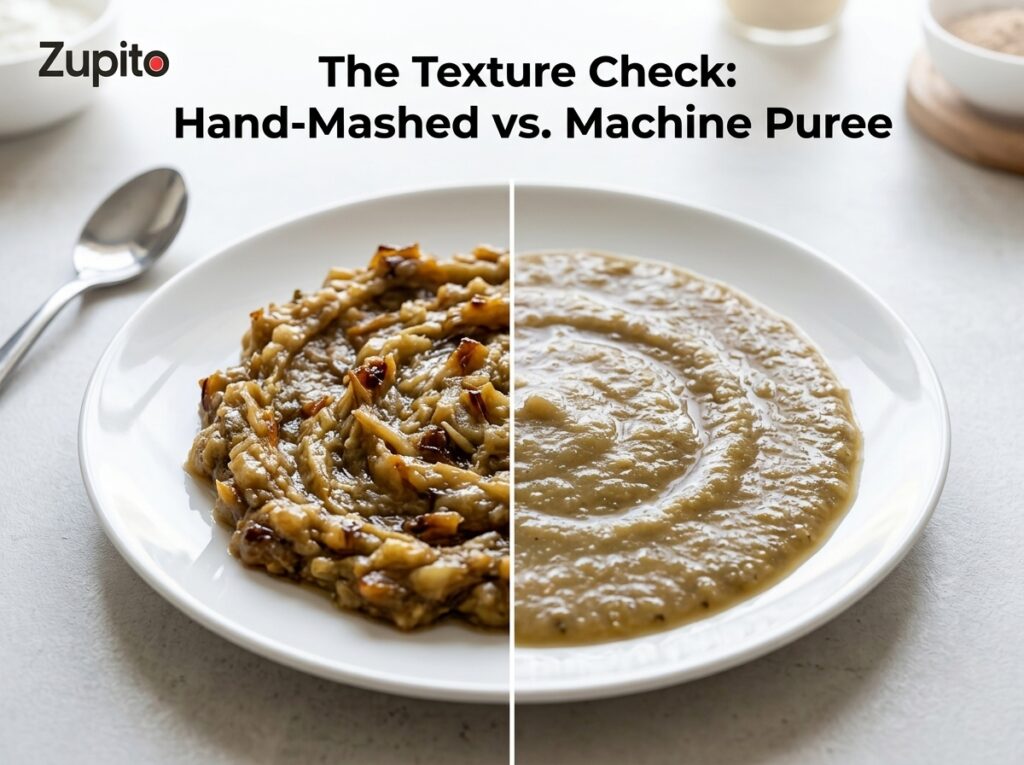
By protecting this raw fibrous matrix through careful manual mashing, you allow your ground ingredients to bind perfectly with the vegetable tissues, creating a rich, uniform mouthfeel that defines premium smoky eggplant curry iterations.
This structural layout ensures that every single mouthful carries a uniform density of both smoke and spice, preventing the oil separation common in over-processed purees.
The Essential Baingan Bharta Spices: Pure Botanicals vs. Industrial Dust
To successfully cut through the deep, heavy char of roasted eggplant flesh, your culinary base requires an incredibly clean, high-essential-oil combination of raw ground ingredients known as real baingan bharta spices.
Standard grocery packets completely fail here because their native oils have been aggressively wiped out during mass commercial manufacturing lines, leaving zero depth in your dish.
When executing your next baingan bharta recipe, focus exclusively on the raw quality, extraction principles, and thermal processing metrics of these three foundational elements:
1. High-Essential-Oil Jeera (Cumin Powder)
Pure cumin contains exceptionally high concentrations of *cuminaldehyde*, a volatile aromatic oil that provides an earthy, warm, and intensely savory counter-balance to open-flame charring.
When introducing cold-ground jeera into your hot mustard oil base, these native oils bloom instantly, laying down a robust savory foundation that synthetic store-bought dust simply cannot replicate.
To see how temperature-controlled cold processing protects these vital volatile components from factory damage, you can analyze our small-batch extraction system over at Zupito Pure Dhaniya Powder and regional ground variants.
2. Low-Temperature Milled Red Chilli Powder
A classic cooking sequence demands a sharp, vibrant kick of heat to wake up the sweet, lazy sugars of the roasted eggplant pulp and activate your raw flavor layer.
Using single-origin, cold-ground chili ensures your dish gets a gorgeous natural crimson hue and a smooth, slow-burning capsaicin distribution without causing internal digestive acidity.
To see how unpolished peppers preserve natural raw pigments without chemical dyes, explore our single-origin flagship asset at Zupito Mathania Lal Mirch Powder.
3. Pristine Haldi Powder (Turmeric)
Pure, unpolished turmeric acts as an essential metabolic anchor inside a traditional baingan bharta recipe, bringing a subtle woody depth that binds the fresh ginger, raw garlic, and sharp green chilis together beautifully.
Industrial brands routinely wash, polish, and chemically alter their turmeric crops using lead chromate or starch texturizers to save factory operational costs.
To protect your home from these dangerous industrial production shortcuts, learn how to run home validation checks inside our master guide 7 Toxic Secrets: How to Spot Real Haldi vs Polished Powder.
Mastering the Dhungar Method for Deep Smoke Infusion
If you lack access to a traditional outdoor clay tandoor or an open woodfire pit, achieving a truly authentic, restaurant-grade dinner can seem completely impossible on modern apartment stovetops.
To resolve this modern bottleneck, ancient Indian culinary science created a brilliant, low-tech smoke redirection system known across the subcontinent as the iconic dhungar method.
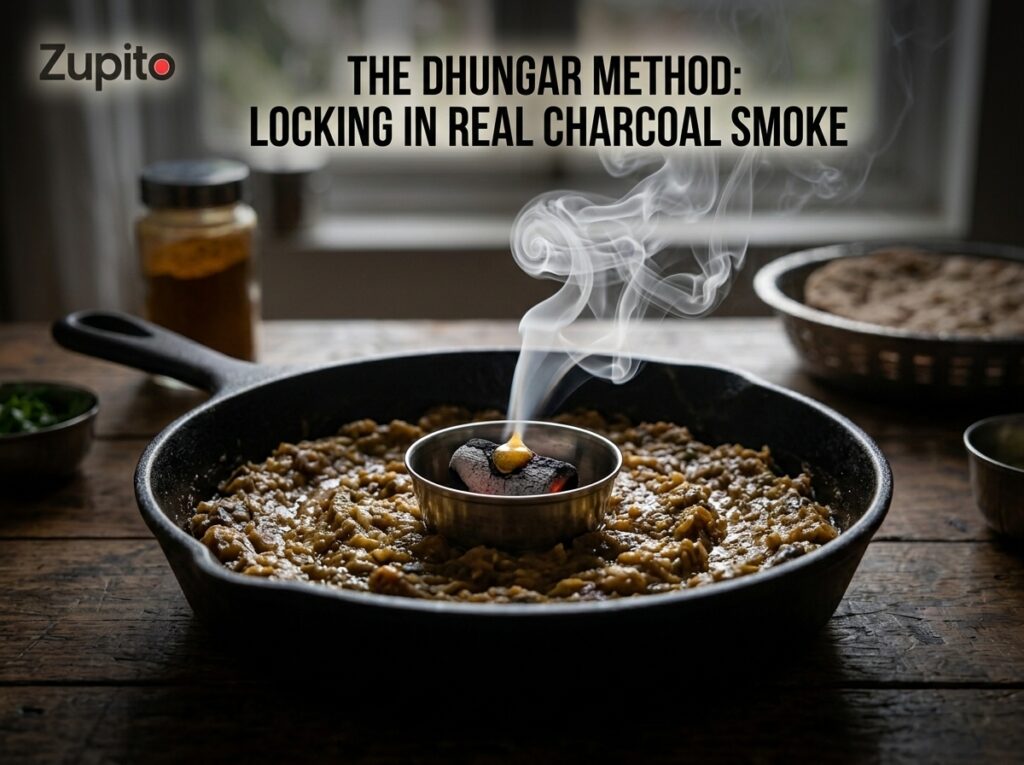
Once your mashed eggplant has fully simmered alongside your premium baingan bharta spices, clear a small, clean physical space right in the dead center of your cooking vessel to initialize the thermal sequence properly.
Place a tiny, heatproof metal bowl or a small piece of natural clay pot directly into that cleared center space to secure your smoke trap.
Using iron tongs, heat a small piece of natural lump charcoal over an open burner until it glows white-hot, then carefully drop the live coal directly into the central bowl.
To activate the smoke transfer during your baingan bharta recipe, pour exactly half a teaspoon of pure cow ghee or raw mustard oil directly onto the glowing white charcoal.
The hot lipid will instantly ignite against the hot coal, unleashing a thick, concentrated plume of intense, aromatic white woodsmoke that completely saturates your smoky eggplant curry.
Slam a tight, heavy lid over the pan immediately, trapping the dense smoke inside for exactly 3 to 5 minutes to allow the lipids inside the dish to permanently trap the passing smoke particles via this targeted dhungar method application.
To guarantee public food safety and ensure zero toxic polymer leakage during high-heat domestic processing, national tracking regulators like the Food Safety and Standards Authority of India (FSSAI) continuously audit compliance metrics across modern consumer food lines.
By pairing the traditional dhungar method with clean, unadulterated ingredients, you elevate a simple preparation into a deep, hyper-authentic culinary experience.
Why High-Speed Industrial Milling Kills Complex Curries
The single most frustrating reason why your homemade dinner ends up tasting like a flat, oily vegetable stew instead of a fragrant dhaba masterpiece lies inside corporate factory supply chains.
Mainstream commercial spice operations pass raw agricultural harvests through high-velocity industrial hammer mills spinning at thousands of rotations per minute, ruining any chance of building a premium taste profile.
This violent mechanical action creates intense internal friction spikes that routinely hit temperatures ranging anywhere from 85°C to 100°C right inside the milling core, permanently scorching your chosen raw powders.
This harsh thermal shock completely boils off the delicate volatile oils, leaving behind an odorless, dead organic dust that ruins your baingan bharta recipe from the very first teaspoon.
The official quality directives published by the Spices Board of India explicitly state that keeping low-temperature control during processing is absolutely vital to protect native essential plant oils.
When you dump dead, heat-damaged powders into a dish, you are forced to add excess oil and artificial flavor enhancers just to make the meal taste passable.
To reclaim the authentic ancestral profile of a true heritage meal, you must shift your pantry toward a dedicated provider that honors cold-milling standards and protects volatile organic assets.
Comparing the Standards: Mass-Market Dust vs. Zupito Pure Spices
Protecting your household from commercial filler shortcuts requires looking clean past attractive grocery labels and analyzing real structural processing metrics.
Evaluate these physical properties whenever you are sourcing high-end raw ingredients for your next weekend kitchen setup:
| Quality Metric | Mass-Market Corporate Brands | Zupito Cold Ground Standard |
|---|---|---|
| Grinding Core Temperature | High frictional spikes up to 100°C that scorch volatile oils. | Strictly managed cold processing kept safely below 30°C. |
| Volatile Oil Retention | Vaporized during milling, leaving dry, tasteless organic dust with dead baingan bharta spices profiles. | Fully preserved native oils that yield a naturally rich, aromatic paste for smoky eggplant curry bases. |
| Chemical Additives | Loaded with industrial starch fillers, anti-caking residues, and dyes. | 100% pure botanical matter with zero artificial chemicals or starches. |
| Smoke-Binding Affinity | Fails to bond with smoke, leaving a bitter, disjointed flavor profile during the dhungar method. | Binds instantly with charcoal smoke to maximize organic flavor profiles. |
Stop Consuming Dead Factory Dust: Upgrade to Zupito
You should never have to sacrifice your family’s long-term metabolic health or wonder if your daily dinner bowls are secretly loaded with cheap industrial starches, chemical anti-caking agents, and toxic synthetic brighteners.
Bringing home a single-origin, temperature-controlled harvest completely removes the ongoing anxiety of trying to find genuine health benefits on unverified corporate grocery shelves.
Every single batch of our custom ground ingredients is processed using state-of-the-art Cold Grinding infrastructure that keeps core temperatures strictly below 30°C, fully shielding the native plant cells and locking in maximum therapeutic value for your household.
This strict commitment to absolute raw purity is why health-conscious families trust our curated ecosystem whenever they want to cook an authentic baingan bharta recipe for their loved ones.
Stop wasting your hard-earned time and money on mass corporate brands and transition your household to a premium spice layout built around complete corporate transparency, ethical farm sourcing, and pristine processing standards.
Give your home the timeless gift of rich, authentic culinary heritage by upgrading your kitchen pantry with authentic, cold-ground cooking selections today.
Make the smart switch to buy pure, cold-ground ingredients online and unlock the complete range of bio-available health benefits by selecting premium Zupito Turmeric Powder for your daily cooking lines.
By choosing an authentic provider that honors ancient botanical balance alongside rigorous modern quality control, you ensure that your household consumes nothing but pure, unadulterated healing molecules with every single bite of your baingan bharta recipe.
Frequently Asked Questions (FAQs)
1. Why does my homemade baingan bharta recipe lack that authentic smoky dhaba flavor?
The signature dhaba flavor missing from your homemade baingan bharta recipe happens when you either skip charring the eggplant skin until completely blackened or use mass-market spices whose essential volatile oils have been burnt off during factory grinding. To fix this, use high-essential-oil, cold-milled spices and apply the traditional dhungar method using a piece of live natural charcoal inside your pan.
2. What is the precise function of the dhungar method inside a smoky eggplant curry?
The dhungar method is an ancient Indian culinary technique used to infuse deep charcoal smoke into a dish on a regular kitchen stove. By dropping a live, red-hot piece of natural charcoal into a small cup inside the cooked mash and pouring ghee over it, you create a dense, aromatic woodsmoke. When covered immediately, the clean plant lipids and fats within your baingan bharta recipe trap these passing smoke particles, locking in a genuine campfire flavor.
3. Can I use a standard electric food processor to mash the eggplant for this baingan bharta recipe?
No, using an electric food processor or high-speed blender completely destroys the fibrous cellular walls of the roasted eggplant pulp, turning it into a watery, unappealing slurry. For an authentic baingan bharta recipe, always mash the charred pulp gently using a manual potato masher or your fingers to preserve the coarse, rich particulate texture that holds onto the spices.
4. How do mass-market baingan bharta spices ruin the digestive benefits of the dish?
Mass-market brands process their raw spices through high-speed hammer mills that hit temperatures close to 100°C. This extreme heat kills off the natural digestive carminative compounds and essential oils (like cuminaldehyde in cumin and curcumin in turmeric). When these dead organic powders are added to a fibrous dish like eggplant, they cause internal inflammation, acidity, and bloating instead of assisting healthy metabolic function.
Explore Zupito Knowledge Hub
- Turmeric Purity Validation: Stop consuming dangerous industrial text lines and master the core techniques of food security inside our master guide 7 Toxic Secrets: How to Spot Real Haldi vs Polished Powder.
- Chilli Powder Quality Metrics: Learn how to analyze industrial starches and trace real single-origin pigments in premium red peppers inside our live 7 Best Chilli Powder Types: Why Mathania Wins Master Guide.
- Sleep & Metabolic Night Recovery: Master how temperature-controlled bio-botanicals fix deep cellular rest by exploring our recipe teardown Spices for Better Sleep: The Ultimate Bedtime Haldi Routine.
- Spiciness Balancing Mechanics: Discover the underlying physical science of neutralizing excess oil capsicum and fixing errors in culinary bases within our live Zupito Spice Combo and Neutralization Assessment Guide.
- Authentic Spice Bundle Upgrade: Break free from mass-market corporate shortcuts and completely overhaul your kitchen setup with our primary guide The 7 Toxic Secrets of Grocery Spices: Why Smart Kitchens Look to Buy Authentic Indian Spices Bundle.
- Chilli Sourcing Mistakes: Learn the exact parameters to detect added artificial colorants and how to safely Buy Chilli Powder Online without falling for cheap factory traps.
- Foundational Curry Emulsions: Master how cold-milled coriander, turmeric, and high-potency oil lipids interlock to stabilize rich gravy structures in our upcoming regional spice integration modules at Shop Zupito Pure Spices & Combos Now.
Leave a Reply